
Should You Melt Your RRSP Into a Non-Registered Account? We Ran 3,000 Simulations
Original Monte Carlo research on RRSP meltdowns in Ontario: when drawing your RRSP down early into a taxable non-registered account pays off, when it costs your heirs, and the simple rule that separates the two. By Marc Pineault, a retirement planner in London, Ontario.
By Marc Pineault, licensed retirement planner in London, Ontario
Published
Take money out of your RRSP early and invest it in a non-registered account only up to the income you will be forced to report later anyway. Past that point, a meltdown is mostly a bet that you will die before about 80. That is the main finding from a Monte Carlo study we ran on Ontario retirees: 3,000 simulated markets, four meltdown sizes, five asset mixes, and every possible age of death from 61 to 100.
An RRSP meltdown means drawing down your RRSP earlier than you have to, usually in your 60s, while your income is low. Moving that money into a TFSA is widely seen as a good idea, and our study took that part as settled. The open question is what to do once the TFSA is full. Is it still worth taking extra money out of the RRSP and investing it in a regular taxable account?
The short answer
- A small top-up nearly always wins. Filling taxable income to about $58,500 (the top of the lowest federal bracket) added roughly $10,000 to $23,000 to the after-tax estate. It came out ahead in 94% to 100% of markets, whenever death came.
- Bigger meltdowns lose unless you die early. Filling income to $75,000 or more won $40,000 to $80,000 if death came by 70, but lost $40,000 to $170,000 for people who lived into their 90s.
- A large RRSP or a defined benefit pension flips the answer. When forced withdrawals would later push income into higher brackets or the OAS clawback, melting to about $95,000 won at every age of death.
- Couples should usually leave the RRSP alone. The spousal rollover and pension splitting keep the RRIF taxed lightly until the second death.
- It does not let you spend more. Safe annual spending moved by less than $1,300 either way.
You can also download the one-page summary (PDF).
How we tested it
We built a year-by-year model of a single Ontario retiree and ran two versions of the same retirement through the same 3,000 simulated markets, so the only difference between them was the meltdown.
- Savings at 60: $800,000 RRSP, $100,000 TFSA plus $50,000 of unused room, $150,000 non-registered.
- Income: CPP of $13,000 and OAS from 65, both indexed.
- Spending, after tax, in today's dollars: $48,000 a year to 74, $42,000 to 84, and $37,000 after that.
- Markets: stocks averaging 6.6% a year with realistic swings, bonds averaging 3.4%, 0.5% assumed fund costs and 2.1% inflation.
- Tax: 2026 federal and Ontario brackets, the Ontario surtax and health premium, age and pension credits, the dividend tax credit, the OAS recovery tax, and mandatory RRIF withdrawals using the CRA's prescribed factors.
- At death: the RRIF is included in income on the final return, as the CRA explains for a deceased RRIF annuitant, unrealized capital gains are taxed, and probate applies to the non-registered account.
The baseline spends from the non-registered account first, then the RRSP, then the TFSA, and tops up the TFSA every year. The meltdown version does exactly the same, plus it withdraws extra RRSP money each year to bring taxable income up to a target, then invests what is left after tax in a non-registered account.
We judged the two versions on one measure: the after-tax estate left to heirs, in today's dollars. We deliberately did not use lifetime tax paid. A strategy can pay less tax in total and still leave a smaller estate, because tax paid earlier gives up years of growth. We also weighted each result by standard life expectancy, so an outcome at 95 counts for less than one at 85.
What the numbers showed
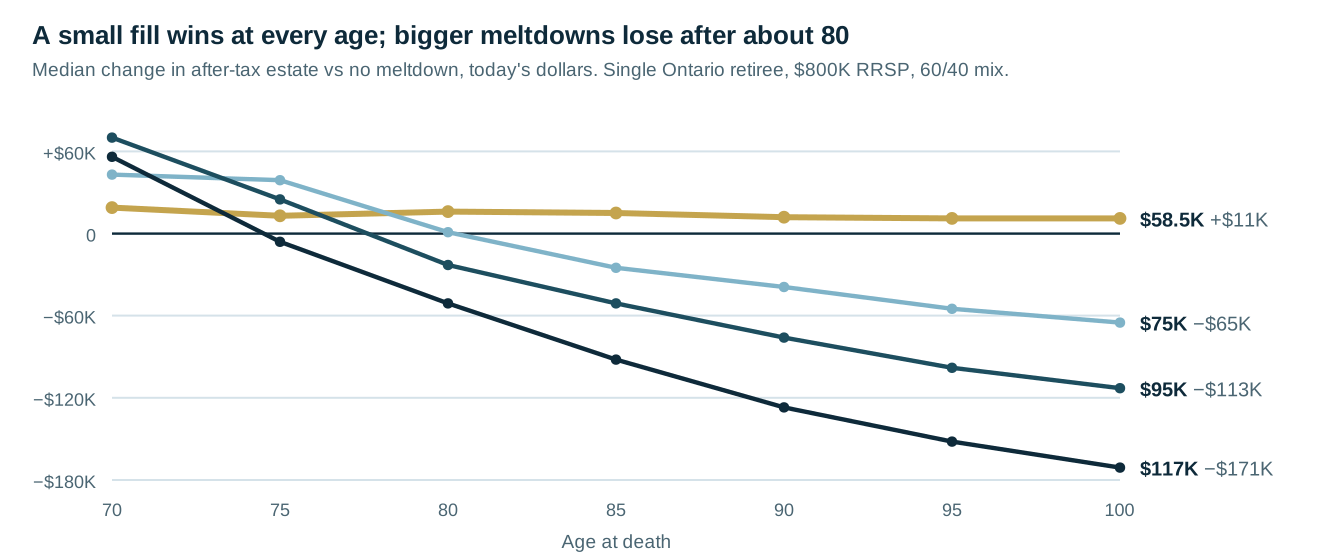
For a single retiree with a balanced 60/40 portfolio, only the smallest meltdown came out ahead once life expectancy was taken into account, by about $15,000. Every larger target won if death came early and fell further behind the longer the person lived.
The age of death at which each meltdown turned into a loss:
- Fill to $58.5K: never. It stayed ahead at every age.
- Fill to $75K: about 81.
- Fill to $95K: about 78, just under the OAS clawback line.
- Fill to $117K: about 75.
The mix of investments moved these results, though not the conclusion. With more stocks, the meltdown looked better, because bond interest in a non-registered account is taxed in full every year while stock gains are taxed at half and only when sold. With an all-stock portfolio, the small fill added about $23,000 and the $75,000 fill roughly broke even. With a bond-heavy 20/80 mix, the small fill added about $10,000 and every larger target lost.
Two other details mattered less than we expected. Holding stocks in the TFSA and non-registered account and bonds in the RRSP improved the small fill slightly and hurt the larger ones. And stopping the meltdown at 71 instead of continuing it for life changed the outcome by only a few thousand dollars.
When the answer flips
The result depends on one thing more than anything else: how much income you will be forced to report later. We changed one input at a time and compared the small fill and the $95,000 fill against doing nothing.
- Large RRSP ($1.6 million): the $95,000 fill won at every age of death, adding about $25,000. RRIF minimums on a balance that size would push income past $95,000 anyway.
- Defined benefit pension ($35,000, indexed): the $95,000 fill also won at every age, adding about $22,000. The pension plus RRIF minimums would otherwise land in the OAS clawback.
- Couple with income splitting: melting lost ground in most scenarios. Even the small fill cost about $14,000 on average and only won if the second death came before about 83. See our guide to pension income splitting in Ontario for why splitting changes the math.
- A 30% market drop in the first year: larger meltdowns did worse, because selling RRSP investments at the bottom locks in the loss.
- Leaving $100,000 to charity at death: larger meltdowns did worse, because the donation credit already offsets much of the tax on the final return.
- Lower returns, CPP at 70, tax-efficient funds, a higher capital gains inclusion rate, or no probate: each moved the numbers by a few thousand dollars without changing the conclusion.
Why it works this way
A meltdown pays only when the tax rate you pay now is lower than the rate the money would face later. Three forces decide that comparison.
The rate on the way out. Money withdrawn at a 20% to 30% marginal rate beats money taxed at 43% to 53% later. For a single person, "later" often means the year of death, when the entire RRIF is added to income on one return. That is why every meltdown size wins if death comes early.
The drag on the way in. Once money sits in a non-registered account, its interest, dividends and realized gains are taxed every year. Inside the RRSP, the full balance keeps compounding untouched. Over 20 or 30 years that difference adds up, which is why larger meltdowns lose for people who live a long time.
Forced withdrawals. From 72, RRIF minimums pull money out whether you need it or not, and the required percentage rises every year. If those withdrawals, plus CPP, OAS and any pension, would land in a high bracket or the clawback zone, melting down to that level first is cheaper. If they would land in a low bracket anyway, melting above that level just pays tax sooner. You can see your own future minimums with our RRIF withdrawal calculator.
Put together, a small fill uses a cheap tax bracket that would otherwise go unused in your 60s. A larger fill pays a middle rate now to avoid a rate you may never face, and gives up years of tax-deferred growth to do it.
A practical rule and five questions
Melt down to the income your forced withdrawals will create later, and no higher. To find that number, estimate what you will receive at 72: your RRIF minimum, CPP, OAS and any pension. That total is a sensible ceiling for the years before.
Before acting, it helps to work through these questions in order:
- Is your TFSA full? Fill it first. Our guide to TFSA versus non-registered accounts explains why.
- Are you single or part of a couple? Couples usually gain little from melting into a taxable account.
- How big is your RRSP compared to your other income? A large RRSP or a defined benefit pension raises your future income, and with it the level worth melting to.
- What do your health and family history suggest? A meltdown pays most when life is shorter than average. Delaying CPP is the opposite bet, and it is hard to make both at once.
- Which matters more to you: spending or your estate? A meltdown barely changes what you can spend. It changes what your heirs receive.
If the answers point toward a meltdown, do it gradually. A set withdrawal each year up to your target works better than one large withdrawal, and stocks are generally a better fit than bonds for the non-registered account. For the mechanics of setting one up, see what a RRIF meltdown is.
Limits of this study
Every model simplifies. Market returns here follow a simple bell curve each year. Inflation is fixed at 2.1%. Life spans come from a standard mortality curve rather than anyone's own health. In the couple case, the first death was set six years before the second. GIS and the rules for re-adding TFSA room after withdrawals were left out, and 2026 tax rules were held constant for life. Results for any one household will differ; the value of the study is the pattern, not the exact dollar figures.
Marc Pineault is a retirement planner in London, Ontario who models withdrawal decisions like this one over a full retirement, one household at a time, before recommending how much to draw from an RRSP and when.
This article is for educational purposes only and does not constitute personalized financial advice. Please consult a qualified professional before making any financial decisions.
Frequently asked questions
Only up to a point. In our simulation of Ontario retirees, filling taxable income to about $58,500 a year came out ahead in almost every market and at every age of death. Larger meltdowns only helped if the person died before roughly 78 to 81. The practical rule is to melt down to the income your RRIF minimums, CPP, OAS and any pension will create later, and no higher.
Usually less than for singles. A RRIF can roll to a surviving spouse without tax, and pension income splitting keeps both spouses in lower brackets while both are alive. In our model, melting into a non-registered account lost money for a typical couple unless the second death came before about 83.
When your forced income later will be high. With a $1.6 million RRSP, or a $35,000 indexed defined benefit pension, melting income up to about $95,000 a year won at every age of death in our simulation, because RRIF minimums would otherwise push income into higher brackets or the OAS clawback.
Barely. In our model, the safe amount a retiree could spend each year changed by less than $1,300 with or without a meltdown. The strategy mainly changes how much your estate keeps after tax, not your lifestyle.
Yes. Moving RRSP money into available TFSA room is widely seen as the stronger move, because growth and withdrawals are tax-free and the TFSA passes to heirs tax-free. Our study treated filling the TFSA as the starting point and tested only the money beyond it.
More articles on this topic: Retirement planning →
Marc Pineault
Retirement Planner in London, Ontario
I help families and business owners in London, Ontario build clear financial plans for retirement, taxes, and investments — then I manage it all so they can stop worrying and start living.
Learn more about me →Enjoyed this article?
Get the next one in your inbox. Financial planning tips from Marc Pineault — practical, Ontario-specific, no spam.
No spam. Unsubscribe anytime.